Groove 3.0: Initial Impressions

With Ray Ozzie popping up seemingly everywhere to push Groove 3.0, I got a chance to test drive Groove 3.0 beta today.  Maybe my initial enthusiasm based on a few screenshots set too high an expectation because I was disappointed by the real stuff.  Groove 3.0 is less like Windows 3.0 and more like Clark Kent trying to change into his Superman outfit in a tight phonebooth.

I like its integration with Outlook, MSN Messenger and Explorer, but Workspaces and Tools are still trapped by the boxy pro-segregation UI which is irritating to both the users and the developers.  Why force the user to abandon the tools they already know how to use and relearn inferior tools?

Why not break open the box completely and let users use whatever tool they are using currently?  Groove 3.0's File Sharing is a good start but even more work is needed to help developers Groove-enable their existing applications.

Anyhow, I am going to play around with it some more and report back later.

Phishing at Wells Fargo

Today's phishing e-mail targeted Wells Fargo customers.

This one gets a minus for not having any compelling stick or carrot.  I mean what is so compelling about viewing a bank account?  It also gets a minus for using a personal e-mail address as sender and rarely used e-mail address as destination.  Smarter crooks are more careful about what to put in the From field.

It seems that phishing crooks are also not shy about wasting target site's resources.  Not only are all the graphics pulled from the legit Wells Fargo site, but some of them are pulled using HTTPS.  Yikes.

Why am I posting these screenshots?  I am doing so because I believe they make more emotional impact than waving some figures.

VCDeploy.exe – Unable To Locate Component

This is a note for those who googled here after running into trouble while writing web services using ATL Server under VS.NET 2003.  I know this is a lame post for the rest of you, but these sort of posts tend to be useful to geeky desperados.

If you get this failure during deployment:

VCDeploy.exe – Unable To Locate Component

This application has failed to start because xxxx.dll was not found.  Re-installing the application may fix this problem.

then move the xxxx.dll to the project directory.  In my case, my web service needed Berkeley DB XML DLLs, but I deployed them directly from the Berkeley DB XML installation directory and ended up with the message above with no clue to be found anywhere.  Well, now there is one.

BTW, you will need to rebuild the entire Berkeley DB XML stack of DLLs if you are trying to use them from VS.NET 2003.  Otherwise, you'll likely crash and burn thanks to runtime library differences.

Information Hailstorm

Just a trail of thought I started today…

While we may have information at our fingertips, we lack control over them in time.  We used to consume news at twice a day, morning and evening.  Now news consumes us any time of the day, whirling around us like a relentless hailstorm.  The worst part of it is that we seem satisfied with living in that hailstorm.

I doubt we can do much about reducing the need for information, but we can do something about making the inflow of information more manageable.  For starters, granuarity of information we are exposed to at one time and the pace of delivery should be addressed.

Phishing at eBay

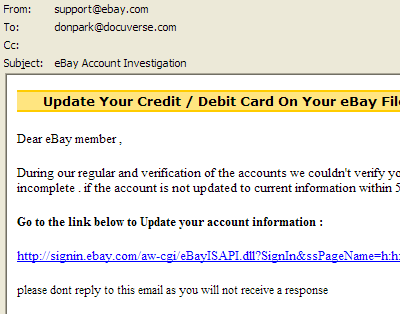
As I mentioned before, I get at least one phishing e-mail everyday and today it was eBay.  I don't use eBay, but phishers don't care.  Its theme was account investigation and the stick was:

if the account is not updated to current information within 5 days then , your access to Buy or Sell on eBay will be restricted

Every link in the page pointed to eBay except the signin link above which pointed to:

http://211.169.249.254/~verification/index.htm

which returns 404 now.  Not very interesting as a phishing attempt but I couldn't resist the cool title.  🙂

e4Graph

e4Graph is an interest project, one I am keeping an eye on as the library matures.  e4Graph is a persistent graph storage library implemented on top of MetaKit.  Here are some relevant words to remember e4Graph by:

reliable, efficient, portable, persistent, storage, graph, C++

While MetaKit is mature, e4Graph is still very much a work in progress.  Still, I think the library will become more popular when we start to notice the limits of native XML databases.

Meanwhile, not having a .NET binding for Berkeley DB XML is frustrating.  Currently, I am using the C++ API in an ISAPI extension that handles access to DB XML.

Looking for Great Web Forms

While web designers are terrific at designing wild variety of great websites, I don't think much attention has been paid to designing great web forms.  From developer's point of view, forms are where the meat is and most forms I have seen are, while functional, neither easy to use nor aesthetically appealing.

I have seen a good looking forms here and there (i.e. TypePad) but it's difficult to find them when you need to pay respect to them.  If you have seen some good looking forms lately, please point them out to me.

Smack and Petri-Net

Smack is an easy to use Java API for XMPP (as in Jabber).  If you haven't heard of it, check it out.  I just wish it was as easy to use other IM technologies.

I felt into a mental hole today and found myself at Petri Nets World.  Since I never had formal training in CS, I haven't had the need to discover Mr. Petri's works until well into my easy-as-pie-compared-to-physics career.  To be truthful, I didn't understand what all the hoopla was about.  Anyway, the website is a good source of information and, particularly, links to useful tools though.  BTW, I like PNK (guide) for testing Petri-Nets.

Beyond Phishing: Content Snatchers

I love discovering little unknown websites with rich contents pulled together by dedicated enthusiasts and professionals.  I also enjoy online specialty stores with wild array of rare products from around the world.  It used to be that one could depend on them being trustworthy if they had a lot of contents because if they invested their time and resources to build the content, they wouldn't disappear overnight.  Well, not anymore.

Recent series of articles by silicon.com show that crooks are stealing small website contents and using them to setup new websites with little changes.  With the right tool, a thief can snatch every byte off a website, scrub off hidden tracking code, and set it up at another domain within a few hours.  Once the site is setup, they can attract new visitors in the same way other sites does, sell advertising or collect credit card numbers until they smell trouble (which could be weeks to months), and disappear without a trace.