RFID Problems

No doubt about it, RFID is hot these days.  While the price of passive RFID is still considered expensive (10 cents or so) for low cost applications like tagging Captain Crunch, moderately priced goods can be tagged now and creative applications are starting to appear.

Unfortunately, RFID is being oversold like magic dust.  For example, primary benefits of RFID to stores like Wal-Mart are supposed to be reduction in labor and theft related costs.  But it doesn't take a genius to see that reducing bodycount at stores and increasing reliance on automated systems will reduce eyeballs and increase complacency which will result in increase of both small and large scale theft leaving people to wonder where has all the RFID tagged stuff has disappeared to several months later.

RFID technology is simple enough to be easily worked around by cloaking RF signals with cheap home-made RF shields and/or switching RFID tags.  Attempt to prevent such gimicks will increase cost.  Yet, I have yet to see serious discussions about these issues.  I doubt Wal-Mart has considered them either.  While I don't mind Wal-Mart volunteering to be the guinea-pig, I don't think their customers do.

I hope to see some more reasonable analysis of RFID benefits and problems than all the hype out there now.  If you know of any, please send me the link.
Invisibility

If you want to be amused, read Wired's Being Invisible article that talks about how one might build an invisibility cloak.  It shows how engineers typically think.  Thankfully, experienced engineers learn to ask questions like "Why is invisibility needed?" and "How near invisibility is sufficient?"

I have learned that one needs to question the validity and nature of the problem being solved.  In the case of invisibility, one has to reach further because invisibility itself is a solution to other problems.  One also must take each word and examine it carefully, taking note of all the assumptions.

Taking invisibility for example, the word means not visible.  Not visible doesn't mean the object of invisiblity has to be there, just that the subject of invisibility is not able to see it.  If I am not there, I am invisible to you.

Slightly harder solution is to have my proxy there, something small enough or hidden deeply enough to avoid being seen.  Another approach is deception, playing with the subject's perception and expectations.  More direct and possibly violent solution is to destroy the subject's ability to see: If you can't see, I am invisible to you.

A thinker must often swim up the river of problems to its source like a salmon.

Cataclysm in UserLand

Ground is shaking in UserLand.  John Robb's abrupt departure and blog disappearance smells bad.  Dave is hinting at a bigger change that should be "net-net good news for Manila and Radio users and for the weblog community."  While going open source is a possibility, "We weren't ready to announce, John surprised us" seems to point to a buyout.  My list of suspects with recent news about AOL's entry into BlogLand are:

  • Yahoo
  • Adobe
  • Symantec
  • Macromedia

Intriguing drama unfolding…

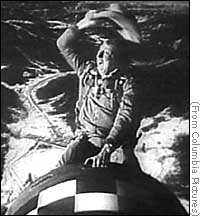
Not Mr. Safe

Mr. Safe is having his 15 minutes of fame and people are posting what they think is the best picture for Mr. Safe.  Well, I couldn't find one I liked, so I thought I would post a picture from one of my favorite movies that is definitely the least likely to be that of Mr. Safe.

Good Mooooorning, Moscow!

Introducing Voltage Security

I have been interested in Identity-based Encryption (IBE) since a VC friend of mine asked me about IdentiCrypt, an attempt to commericalize Stanford IBE project, almost two years ago.  I am not a crypto expert in any sense, but I know how to put together a product, especially easy to use consumer products, and all the pain and mistakes one can make while trying to do so.

I took a look and found a lot of potential in IBE although IdentiCrypt's execution was amateurish at the time.  So I volunteered to help them but got nothing in response.  I guessed they were too busy talking to VCs and continued to monitor the IBE technology.  I knew that they got funded but not much else since they were in stealth mode.  Today, they unveiled themselves as Voltage SecurityCool name, BTW.

Scott Loftesness is one of their advisors.  You can't get a better advisor than Scott IMHO.  Here is Scott's own words on Voltage Security.  Looking at their board, looks like Hummer Winblad, Morgenthaler, and a few well-known individuals invested in the company.  The company is headed by Sathvik Krishnamurthy from ValiCert.  I don't know Sathvik, but I had been impressed in the past with ValiCert's ability to make a big deal out of seemingly nothing.  Since Sathvik was VP of marketing and business development at ValiCert, I have to say Voltage is in good hands.

I haven't looked into their product yet so I can't say much about them yet.  Meanwhile, I would like to welcome Voltage Security to the security market and a hearty congratulations to them for successfully navigating the VC waters.  Good luck to them also.  They will need plenty of it!

If I had an advice to give them, it would be this:

Think of cryptography and security as the engine and chasis of the car you are selling.  While they are both important, rest of the car is what sells the car because people can't buy what they can't see.  Don't make the same mistakes most security companies make by hiring mostly crypto and security experts.

Update 1: Link to Tim Oren's post about Voltage where he mentioned above as a sage advice.  Thanks Tim.  I think the first advice I had given was telling my parents to stop fighting like little children when I was eight or so.  Here is a confession: I gave that advice so I can sleep at night.

Lost Art of Insults

A TIME article reflecting my appreciation for good insults.  Woo, I forgot about the Churchill classic:

If I were your wife I would put poison in your coffee. – Lady Astor

And if I were your husband I would drink it. – Churchill

And a good observation from the article:

"If the N word has become devalued by overuse, so has the currency of moral indignation."

A good insult make you think it over and then hopefully appreciate it with a good chuckle and respond in kind while remaining civil.  Unfortunately, today's insults are just repeats of common foul words or what we see on TV.

Art of insult delivery has gone down hill too.  Today, people think a loud torrent of verbal abuse like the one we often see Eminem or the loose half of two stars in buddy cop movies frequently do is what a good insult is.  Even the intellects think slipping sly messages between the line makes good insults.

Growing Things

A few months ago, my wife dug a hole and buried some roots of green onions.  Look what we have in our kitchen today: green onions!  We do that often when we have something that might grow.  Er, don't bury bamboos though.  You'll regret it.

This reminds me of a trick I wanted to try on my dog.  Unfortunately, she died two years ago.  She was a beautiful black Pekinese.  Now I just have two birds.  Since they might be bored, I perform five-minute shows in front of the birdcage everyday to keep them entertained.  So far they haven't booed me.  I might have the start of a second career here: Bird Entertainer.

Getting back to the trick, if you have a dog that likes to bury bones, try this trick.  When the dog is not around, unearth the bones and either replace it with something else or put more bones in there.  Heehee.  Your dog just might start a bone farm.

Daily Habit

When I started this blog, I tried to come up with a cool name like other bloggers but couldn't think of any.  Today, it dropped on me out of the blue: Daily Habit.  Being a newage narcissist, I left my name in there.  Let's have a round of applause for the new name:

Don Park's Daily Habit

Woohoo!  Aiyaiya!

FYI, the font used to display the title is Georgia…I think.  I am not a font fanatic.