Java3D Dead?

According to this java.net weblog post by Chris Adamson, Java3D is done for in favor of JOGL, an open source Java binding for OpenGL.  JOGL, now why does that sound familiar?

I wrote an open source Java binding for OpenGL way back in 1996 called JOG (Java OpenGL).  After releasing it, I moved on and it eventually got lost during one of many ISP changes.  I am sure I still have the source code somewhere on a floppy, but I barely remembered its name.  Only trace of JOG left on the web was this OpenGL Language Bindings page which was updated last in 1997.  I wonder if any of my JOG code made its way into JOGL…

Zen Addicts

I like meditating and reading Zen books, but I am uncomfortable with the formality of Zen monastaries because I can't help feeling that they are making a religion out of Zen.  I suppose I could shift my views into seeing them as a hospital of sort, but I am lazy.  To me, Zen is no different from Cindy Crawford's exercise video.  It is just a way to feel good, or at least, not feel bad.

Certain body positions that are more comfortable than others.  When you sit on the ground, there could also be some pebble under you, forcing you to shift your butt until you find a comfortable position.  This is what Zen is to me except it is about how your mind sits rather than your behind.

Body position also affects how you think or rather the extent of control over mind.  As for me, I don't like the way I have to hold my body and breathing pattern in certain ways just to feel better.  It's like moving and holding TV antenna in a certain position to receive better TV signal.  While I like watching PBS, I don't mind being stuck with watching soap operas.

Zen koans helps you move your mental butt.  It works by being obscure, same mechanism that provokes mammals to tilt their head slightly whenever they see something they don't recognize.  Zen koan makes you tilt your mind to understand words that make no sense otherwise.  In doing so, you change your perspective and you change as well — you are where you sit.

Frequently, I run into people are obsessed with Zen.  Some of them become monks.  Shaving one's head, aside from the symbolism and marketing side of it, is just a way to focus.  Avoiding meat reduces the chance of being swept away in a flood of emotions triggered or aided by certain chemical.  Still, I don't see the point of bleeching all the colors out of your life.  Being addicted to tranquility and illusion of clarity is a real danger for Zen practioners.

Of course, there are a number of wilder strains in Zen as exemplified by famously crazy Zen monks dotting the history of East Asia.  In Korea, there was a monk who practiced calligraphy with a brush attached to his penis.  Amusing and admirable in a way, but still trapped by the desire to be enlightened.  Very few ever experience the enlightenment.  Even more sad, few talk about how fleeting enlightenment might be.

So, I would like offer this piece of advice to those interested in Zen:

Take what you need and no more.

XML Namespace Ownership

During a discussion with Mark Pilgrim over some Atom extensibility issues, I ran into some questions which are likely to be controversial:

Who owns a XML namespace?

A XML namespace URI is supposed to be just an opaque string that is unique enough to identify a namespace.  It is not a place so the question of ownership is different the question of link ownership.  I suppose one could apply trademark or copyright laws to XML Namespace URIs.

If one can exercise legal control over XML namespaces, what are the legal implications of standard organizations like W3C owning key XML namespaces?  I am not a lawyer, no can I think like one so I'll punt this question.  But we are likely to see clauses appearing in specs related to XML namespaces.

Should XML namespaces be Open or Closed?

An open XML namespace allows third-parties to add new names according to a strict naming design pattern.  Are there use-cases where there is a need for XML namespaces to be open?  What about nested XML processor plugin frameworks that uses XML Namespace URI?

There is also the question of rogue tags being carried as a hidden beacon of sort across the Net and into Intranet.  If unknown tags are ignored by default everywhere, what are the security and legal implications?  If my web service logs all invokations and someone slips in copyrighted or illegal information into a SOAP call, am I liable?  There is a whole new type of cross-scripting issues in web services.

An Example of Emergent Markup Languages

This morning I came across a great example of Emergent Markup Languages I posted about in the past while scanning through Marc's blog.  In a post about social webware  and Burning Man, I saw this paragraph:

We'll have to provide a small extension to MT so that MT can help people semantically tag their blog entries with <want> and <have> as well as <geo:Point> and <geo:Time>.

Wow.  What a powerful pair of emergent meta tags or metags.

Update #1: A recommended reading, Sean McGrath's Zen and the Art of Motorcycle Manuals.  Thanks to Phil Wolff for the reminder.

Software Update/Distribution Pipeline

Macromedia has released a public beta of Flash Player 7.  Guess what, Flash 7 adds automatic notification and update.  QuickTime has it, Real Player has it, Java has it, and now Flash has it.

Could we please get together and build a SINGLE public pipeline instead of all these private implementations each of which waste memory and bandwidth unnecessarily and configuration and usability mess?  One pipeline and one UI for everyone is what I want.

We can either arm-wrestle Microsoft into giving us access to its Windows Update facility, or build out own.  Anything but this everybody build their own private pipeline nonsense.

Pie/Echo/Atom (PEA) Dinner

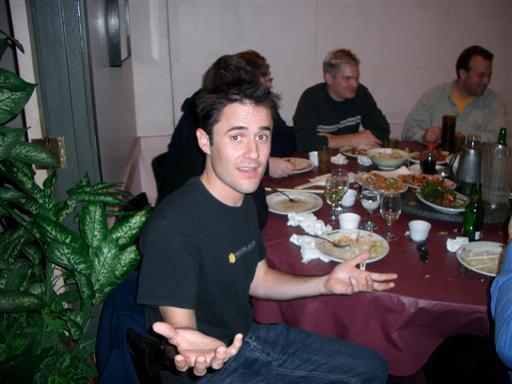
Pie/Echo/Atom (PEA) dinner was held yesterday at Hunan on Sansome just off the seaward side of Broadway.  David Galbraith and I met before the dinner at Bastille.  After tossing a great salad of ideas over beer, we trekked up toward Broadway.  Oy.  I hate walking uphill.  My flatfoot didn't help either.  When we got to Hunan, there were about twenty people already waiting to be seated.  Then the dinner happened.  Here are some pictures I took.

This blog dinner was more technical than usual since because it was centered around PEA topics.  I had some good technical exchange with Sam Ruby, David Sifry, and Mark Pilgrim who were sitting at my table.  At one point, I asked "What happened to the appkey?" to which Mark echoed (sorry) and Sam scratched.  Yes, appkey is not in the Atom API.  So I walked over to Evan Williams and asked the same question and his answer was:

What appkeys?

We all had a good laugh about it but concluded that appkey should be added to the Atom API.  I think appkey is not a viable solution in most commercial applications, but it does the job as an interim solution and should be supported as an optional parameter.

Overall, I had a great time and got some great ideas from the dinner.  It wasn't really anything specific anyone said at the dinner.  It was more like gaining sudden insights in a struggle to make sense of all the opinions, ideas, questions, and answers flying around.  Yes, that's it.  That is where the money is.  Too bad Joi wasn't around when I got to that part.

Dinner rollcall from Christian Crumlish:

Christian Crumlish, Mark Nottingham, John Beatty, Mark Graham, Dan Beldy, Jay Feinberg, Nick Chalko, Marc Canter, Kevin Burton, Sam Ruby, Phil Wolff, Don Park, Greg Reinacker, Simon Fell, Mark Pilgrim, Chris Alden, Joi Ito, Jason Shellen, Evan Williams, David Galbraith, David Sifry, Joe Gregorio

Pictures: