2D Graphics Libraries

While platforms these days have fairly good 2D graphics support like Quartz on OSX, GDI+ on XP, and , and Gnome Canvas, developers like me often have to use third-party libraries for whatever reasons.  On Win32, for example, GDI+ support is missing in legacy platforms which means either giving up on fancy graphics, redistributing GDI+ binaries, use a third party library, or writing one yourself.  Writing one yourself is fun (I have done it a couple of times over 20 years) but, unless it offers some unique features, you'll always end up migrating to a third party library.

BTW, Flash has an excellent 2D graphics engine but it's lacks an API so it's like a sports car without a driving wheel.  Yes, you can embed the Flash ActiveX and generate SWF on-the-fly but it's unwieldy for dynamic interaction and even handling gets tricky.  Embedding Adobe SVG ActiveX is just as unwieldy if not more.

While there are proprietary 2D engines out there, typically written by a few guys at a small company, they tend to disappear within a couple of years, either bought by companies (i.e. Apple, Adobe, Macromind, and Microsoft), or abandoned out of lack of interest or workable revenue model.  Besides, they charge fairly steep fees so I tend to avoid them.

Out of all the freely available 2D libraries out there, Libart stands out in features and quality.   It offers fast anti-aliased rendering and it's use in Gnome Canvas over the years means most of the bugs have already been stepped on.  Libart is also used to drive librsvg, a SVG engine, and Java 2D, Java's graphics API, although Sun made extensive changes to tap hardware acceleration.  While Libart can and has been used cross-platform, it's not exactly cakewalk to use in non-Linix platofrms.  Cairo has some interesting features and rising interest could mean it will replace Libart someday, but it's still in development.

Third-party 2D graphics library I really like these days is Anti-Grain Geometry (AGG) which, although dormant for the last two years, has been rejuvenated with the released of version 2.1.  AGG is written in C++ and uses templates extensively like ATL does.  AGG is lightweight, very fast, flexible, and full of features.  It even comes with a partial implementation of SVG viewer as an example.  AGG supports Win32, X11, and SDL as is.  It doesn't yet support features variable stroke effects like Creature House's Expression 3 engine and Fractal Design's Painter support but then it's just me being unreasonable. 🙂

I should note that subpixel graphics was first done 20 years ago in Word Handler to display 70 columns of hi-res text on Apple II.  Silicon Valley Systems, the company that published Word Handler, was based just 5 minutes from where I live now and I enjoy fond memories of working there every time I pass by the old office on El Camino.  I guess everybody remembers their first job.  LCD screens were just starting to replace LED on calculators at the time, so Steve Gibson and Microsoft ClearType can claim to be the first to use subpixel graphics on LCD screen.  Lenny Elekman, where are you now?

Update:

I thought I should put this excerpt from the AGG doc, which is still being written, for those who are expecting GDI+ or Quartz like API from AGG.

Anti-Grain Geometry is not a solid graphic library and it's not very easy to use. I consider AGG as a “tool to create other tools”. It means that there's no “Graphics” object or something like that, instead, AGG consists of a number of loosely coupled algorithms that can be used together or separately. All of them have well defined interfaces and absolute minimum of implicit or explicit dependencies.

In fact, AGG is just a bunch of C++ template classes which little or no documentation to guide you except the examples.  Don't wade into AGG unless you know what you are doing.
Master and Commander

I finally saw the movie Master and Commander today.  While the movie was very well made, I didn't enjoy it as much as I enjoyed the books.  Also I felt Russell Crowe portrayed Captain Aubrey too differently.  Aubrey I know is more stoic, drier character who gains respect by doing.  Russell Crowe's Aubrey was wittier and flimsier.  Maturin was also too young and seemed too inexperienced.  Still, I enjoyed the action at sea although I wish there was more battle scenes and ships manuevering.

Spams, Phishing, and Trojans

This Netcraft article titled Phisher Kings compares growth of phishing with that of spamming (via Payments News).  It's not surprising to me since I think phishers who rely mostly on social engineering used to be spammers.  However, phishers using trojans, like the one described in this Code Fish Spam Watch article, are not.  They are hackers using e-mail to find their victims.

Using trojans to harvest passwords and credit card numbers is, fortunately, not as deadly as it might seem at first glance.  Why?  Because trojans require more technical knowledge, higher cost of maintenance, and higher cost of labor necessary to mine the returned data.  It's all glory and little in return.

In comparison, phishers with spamming background tend to focus on what really matters, the ROI numbers.  Instead of wasting days and weeks to write and finetune trojans, they use a web page editor to create their lures and receive their loots in ready to use form.

There is a more dangerous group of potential phishers we need to keep an eye out for: telemarketers.  While most spammers operate blindly, telemarketers leverage information to choose and attack their victims more intelligently.  Phishers with telemarketing background are more likely to be spear-phishers, phishers who target rich victims with tailored attacks.

When they come for you, they will know your name, where you live, what finanicial services you are using, and more.

42nd

Today is my 42nd birthday and I have yet to wake up.  I like to run away alone to some quiet corner of the world on my birthdays, but haven't been able to since I got married.  I wish I could be standing somewhere in Tibet right now, completely lost and grinning for no reason at all.

I want to be somewhere where I don't have to think about things like Bush, Iraq, Google, or Atom.  And I want to be there without hours of jet engine noise.  Maybe I want to get there in a merchant ship, puking across the Pacific and telling passing whales 'sorry but you piss in there too, don't ya?'

Why do I like to get away on my birthdays?  Well, I do get into a really weird mood in the first place, and I want to remember all of my birthdays by eccentric events.  Living the everyday life is like living in a mine, you can't tell what time it is without a watch.  It's like being told the wind outside is 30mph instead of feeling the wind on your face.  Being alone and somewhere I never been before lets me feel the 'wind' of life as it passes by.

Oh, heck.  Maybe when I retire, I'll pickup my travelling stick again.  Until then, bitching is all I'll be doing.

Secure UI: 9-Block Phishmarks

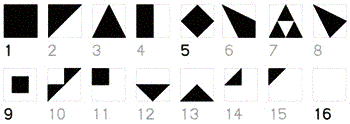
When I originally came up with the idea of phishmarking, I was thinking of using fractal patterns.  Unfortunately, fractual patterns are rarely simple symmetrical designs so they are more difficult to remember.  So while I was looking for a different approach, I remembered Jared Tarbell's 9-Block Pattern Generator at Levitated.net which basically does what quilt makers have been doing for ages but with simple shapes that can be used to build a shape that is easy to recognize even at small size.

It uses following 16 shapes, rotations, colors, inversion, and some rule for symmetry to generate astonishing number of designs.

Below is my implementation of 9-block phishmarks being used in browser toolbars.  Note that phishmarks are anti-aliased because the display area on the toolbar was too small.  Cool, eh?

Pretty and Safe!

BTW, Jared told me that 9-block pattern generation algorithm can be used without a license although his Flash code is under GPL.  Jared also has other interesting graphics generators that could be used for phishmarking although I am not sure about licensing.  For example, Bone Piles and Combinatorial Critters are pretty interesting although they will require more real estate and more complex coloring schemes.

9-block quilts are very interesting although not enough to make me want to take up the sewing needle.  Heh.  Anyway, if you want to find out more, here are some links to get you staretd:

Update:

To be more precise about how many unique patterns can be generated, above implementation uses 17 bits for the pattern (3 bits for the middle shape and 7 bits each for corner and side shapes) plus foreground and background colors.  Taking limits of human vision and color restrictions, I would say this implementation of 9-block phishmarks can generate around a billion easily recognizable unique patterns.  That's enough, I think, against phishing.

If not, adding a few more shapes will be enough to assign a unique design for every single person on earth.  Hmm.  Wouldn't it be interesting to assign one to each last names so they can be used as 'house' symbols?

Update #2:

Please read the post about PassMark patent that could affect this and other phishmarks.

Searching for Algorithms and Data Structures

In the old days, finding obscure algorithms and data structures meant keeping stacks of books and trade journals in the garage, visiting book stores and local universities to dig through mountains of books and badly written and copied research papers.

Even in the Bay Area where there are great bookstores and two large universities, it wasn't easy.  Whenever I read about something neat like Linda or spiral hashing, I drove over to the Stanford math & CS library and spent hours going through papers.  Finding the paper often mean having to read papers mentioned in the paper so it was a good way to waste a whole day in that dusty library.

Thanks the Net, all that is replaced by Google and excellent services like CiteSeer and NIST WebSpaceNIST Dictionary of Algorithms and Data Structures is useful too, although it's not as complete as I would like.  Unfortunately, most of these services are not updating their stat pages as often as I would like.  For example, this list of most-accessed documents at CiteSeer was last updated in June 2003.

I wish these valuable services had easy ways to donate (PayPal?) because I think they are absolutely essential to my work and I want them to improve and expand their services.  For example, wouldn't it be great if documents at CiteSeer were Wiki pages?  This way, corrections to errors in the papers and implementations can be shared.

Replacing Notepad Again

When I replaced the silly Notepad last time, I switched to SciTE.  While SciTE was good, its UI was non-standard and the single binary packaging version had some irritating problems such as config file updating.  Still it was better and it's syntax hilighting was really helpful.

Now there is a better option: Florian Balmer's Notepad2 (via Omar Shahine).

Notepad2 seems to offer everything SciTE did and without having to live with it's weird UI.  And it also comes with source code if you need to make changes.

To install, you can follow Omar's directions or do the samething I did last time.  Here is a copy with appropriate changes.

How to replace Notepad.exe on Windows XP

Windows XP has file protection so Notepad.exe will get restored if you just replace the file with renamed Notepad2.exe.  Follow these steps:

  1. Download Notepad2.zip, expand and rename Notepad2.exe to Notepad.exe
  2. Save a copy of the original Notepad.exe somewhere.
  3. Replace Notepad.exe in following three locations (order is significant):
     
    • %WINDIR%\System32\DllCache
    • %WINDIR%\System32
    • %WINDIR%

      *%WINDIR% is your Windows folder (i.e. C:\Windows)
       

  4. Press Cancel when a warning dialog appears.