Yawn as a meme

While reading Janne's (aka Ecyrd and creator of JSPWiki) blog, I ran across a post titled YAWN with this:

11:49 * DonPark YAWNS. 11:48 * Ecyrd haukottelee

I yawned textually on #joiito IRC channel recently and the yawn spread to not only people on the channel but also to other channels by those logged into multiple channels.  Janne concludes that:

Yawning has amazing power. We truly are social creatures.

Yawn is a special type of meme, a highly infectious notion that evaporates within seconds of infection.  In fact, it is one of very few memes that can infect across species.

Wiki-based Websites

Some folks are experimenting with using Wiki to build websites.  I particularly like what Matt Haughey did with PHPWiki and a bit of CSS magic dust.  Looks nice, eh?  [Via Seb's Wikis are Ugly? post at Corante]

Janne Jalkanen's Wiki-based Weblog is interesting too.  Hmm.  Maybe blog API(s) can be used for Wikis too.  That reminds me, shouldn't Wiki formatted text have their own MIME type?  Is there one?  "text/wiki"?  For now, different dialects of Wiki formatting rules will have to be accounted for like "text/wiki+moinmoin".

Update #1: I found this nice page listing Wiki and Weblog hybrids.

C-JDBC

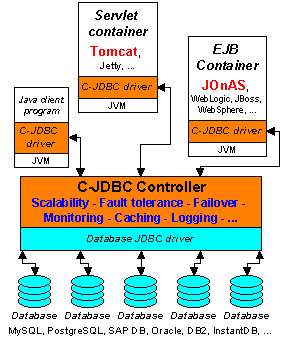
C-JDBC is a JDBC driver that adds failover, load balancing, caching, and monitoring capabilities to your Java web application.  Neat.  Whenever I had to do this myself for past projects, hardest part was testing.  Setting up and simulating loads and failures among clusters of app servers and databases is not fun.  Now I can use C-JDBC instead of cooking up my own brew.

Blogging to Wiki

Many people have responded heartily to my Linking Blogs and Wiki post, most interesting one being Sébastien Paquet's Mountains and Lakes post which points to TopicExchange created by Seb and Phil.  All the responses begs the following question:

Where is the standard API for Wiki?

Without a standard API, it's difficult to connect blogs and wikis together.  It's a pretty silly question actually.  Wiki doesn't even have a standard format!  What do I have to say about the current state of Wiki technology?  Just this:

Wiki is f**ked up.

Stop running around like Gully Dwarves and get your act together guys.

Update #1

I found Wikipedia API in Python project at SourceForge.  It's still in planning stage, but I am happy to see some movement in Wiki API space.

Michael Wilson thinks Wiki doesn't need a standard API.  He wrote:

"Leave wikis alone for gods sake.  Standardization fetshism doesn't really help much."

Nobody is forcing you to change, Michael.  Also, I haven't mentioned anything about standard organizations.  Just get few key players together and bang out a common syntax and API that works.  The common syntax doesn't have to be used directly by 'puncs' who are already used to their own local brew.  Just use it as an exchange format.

OpenSSL and Application Complexity

Whew.  My schedule is now back to normal and caught up with my share of Zs.  During my rush, I ran into a possible bug in OpenSSL that caused its random number generator to take more than a minute to initialize when the application heap is overly complex.  The code also crashed in the same 'complex' application environment when executing in a separate thread.

A collegue of mine told me that it might be due to a 'controversial' code within OpenSSL so I am trying to disable that code this morning to see if that makes a difference.  It's silly how supposedly stable code like OpenSSL can become unstable under 'normal' desktop application environment.  Using the delay as a measure of complexity, Netscape 4 takes a few seconds, IE takes tens of seconds, and Acrobat 6 takes a minute.

Update #1: Debugging inside OpenSSL code confirmed that the problem was with Win32 implementation of RAND_poll (rand_win.c) which walks through all the heaps to harvest 8 bits of entropy per block.  There was an upper bound on the number of blocks (50 in the version I had, 80 in latest), but no bound on the number of heaps.  Usually applications use small number of heaps, but Acrobat 6 had 26 heaps.  More heaps and blocks you check, more chance of contention.  Ouch.

My solution was to put a reasonable limit to number of heaps checked.  Maximum of 5 heaps capped the PRNG init time to about 7 seconds instead of 60 seconds or more.  Phew.  I hate messing in crypto crap.

Ping

I was too tired in the last two days to post anything, not enough sleep, chasing a deadline.  My blogging will return after today's deadline sponsored by the Letter A, A, I, and W.