Linking Blogs and Wikis: Part 2

This is contiznuation of my Linking Blogs and Wikis  post.  Other related posts are Blogging to Wiki and Bleeding Edge of Wiki-Blog Hybrids.

Using a Wiki Page for Blog Comments

I think wikis can replace blog comments right away.  Most blog comments are text-only so use of wiki text formating rules and WikiWords is optional.  When a comment about a post is received either directly from blog tools/services or indirectly via a spider, monitor, or another blogger, receiving script can create or find a wiki page to add the comment and the original post to the page.

One great benefit is that comments are no longer second class information: isolated, unindexed, and often overlooked.

Wiki to Trackback and Congregate

The script can also walk through links mentioned in the comment or original post to discover related blog posts and drop a comment as breadcrumb for other bloggers to follow.  This functionality is like trackback but with added benefit of congregating bloggers and commenters to a shared space.

Duplicates

There is the possibility of multiple wiki page being created for a single 'conversation', but most of them should be mergeable automatically.  Still, more thought is needed here.

Blogs within Wikis and Pageroll

In wikis I have seen, some users create a personal wiki page mapped to the user's name as WikiWord, where users can add personal information there.  There is also a way to retrieve a wiki page containing the history of a user's activity within the wiki.

I think these pages can be redesigned to resemble a blog with its own set of RSS feeds.  User activity history can become a category within that blog.  Auto-population of blogroll is also possible here with names of people the user interacted with.  In this context, wiki pageroll listing wiki pages the user frequents makes sense.

My brain is still humming with thoughts on ways to combine blogs with wikis.  Between the two technologies, Wiki is the fragile one so I am trying to take extra care not to kill the humming bird.  Stay tuned.

Update: Richard MacManus responds with Tracking conversations with Wikis and Extending blogrollsSheesh.  I wouldn't have to do this by hand if Wiki replaced both blog comment and trackback.

Picking Wiki Bones

I am playing with JSPWiki this Sunday.  It's easy to install and easy to play with.  I just dropped in to my local Caucho Resin's webapps folder, changed some jspwiki.properties settings and off it went.  Oops.  Not having any wiki page is no fun, so I expand sample wiki pages that came with the distribution into a folder designated as wiki file storage.  At this point, it's ready for play.

Trying to understand the Wiki technology is like dissecting a Humming Bird: it's difficult to find the meat.  In flight, it's wonderful.  Take it apart to see what makes it tick and there is nothing there, just bits of feathers and bones put together using spider web and Harpy dust.

Pipe Organ with One Thousand Keys

I frequently think about human mind works because I am always looking for a better handle on my own.  A better handle in real term is a good model.  My latest model is a pipe organ with a thousand keys.  BTW, one thousand is just a number I picked.

Imagine a huge pipe organ with a row of just ten keys.  Each key represents a part of a mind and pressing it evokes thoughts or emotions.  Since it's a pipe organ, pressure matters.  Now replace the row of keys with a table of 100 keys.  Easy so far.  Take one more step and imagine 10 stacks of keys.  Now you have a cube of 1000 keys.  At this point, you have to lose rest of the organ, and keep just the keys.

Keys on the outside of the cube are pressed by what goes on outside the mind.  Pressing a key cause other other keys within the cube to be pressed, creating a sequence of notes and cords of thoughts, a music of sort.  Some relationships between keys are inherent, but most are learned.  Relationship also depends on the amount of pressure applied to a key and what keys were pressed before.

It doesn't really matter whether this model is valid or not.  What matters is what new music it will play as I hold the model in my mind.  At this moment, I am playing a slightly funky music in my head.

Bleeding Edge of Wiki-Blog Hybrids

Janne, author of JSPWiki, reveals what is going on at the bleeding edge of Wiki-Blog hybrid technology.

"First, a short explanation on the tech behind this weblog: This is an instance of JSPWiki, where each entry is a separate WikiPage?. The Main page aggregates then all of the pages which have a certain signature in their name onto the front page, producing the weblog you see right now. This allows cool stuff like doing collection pages, such as Ropecon2003, or EGC2003, where I just insert a string like [{WeblogPlugin startDate='310103' days='31'}] to get all of the entries from January 2003, for example." – Butt Ugly

In essence, JSPWiki is a Wiki with the ability to pull together a blog-like page out of Wiki pages.  Throw in page template to add style and other blogging essentials like calendar and blogroll, you got a blog.  Neato.

Janne also talks about his XML-RPC-based API for JSPWiki.  JSPWiki also supports MetaWeblogAPI.  Les Orchard, Mr. 0xDECAFBAD, has implemented the API for TWiki, UseModWiki, and MoinMoin.  Les is considering REST version currently.

On the syntax front, Janne mentioned the WikiML initiative by Eric van der Vlist, an old pal from my XML/SML days.  There is also WikiXmlDtd effort by UseMod folks.  Wiki Interchange Format page is also worth a read.

<

p dir=”ltr”>Based on my recent scouring of the Wiki technologies, JSPWiki (Java/LGPL) and TWiki (Perl/GPL) are worth keeping an eye on, JSPWiki on the wiki/blog/api front and TWiki on the extension front.  There is also SocialText, of course, but I don't know what differentiates their commercial Wiki implementation from popular free open source Wiki implementations other than service.  Perhaps Ross or Peter can explain.

Yawn as a meme

While reading Janne's (aka Ecyrd and creator of JSPWiki) blog, I ran across a post titled YAWN with this:

11:49 * DonPark YAWNS. 11:48 * Ecyrd haukottelee

I yawned textually on #joiito IRC channel recently and the yawn spread to not only people on the channel but also to other channels by those logged into multiple channels.  Janne concludes that:

Yawning has amazing power. We truly are social creatures.

Yawn is a special type of meme, a highly infectious notion that evaporates within seconds of infection.  In fact, it is one of very few memes that can infect across species.

Wiki-based Websites

Some folks are experimenting with using Wiki to build websites.  I particularly like what Matt Haughey did with PHPWiki and a bit of CSS magic dust.  Looks nice, eh?  [Via Seb's Wikis are Ugly? post at Corante]

Janne Jalkanen's Wiki-based Weblog is interesting too.  Hmm.  Maybe blog API(s) can be used for Wikis too.  That reminds me, shouldn't Wiki formatted text have their own MIME type?  Is there one?  "text/wiki"?  For now, different dialects of Wiki formatting rules will have to be accounted for like "text/wiki+moinmoin".

Update #1: I found this nice page listing Wiki and Weblog hybrids.

C-JDBC

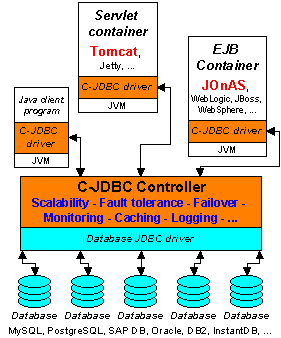
C-JDBC is a JDBC driver that adds failover, load balancing, caching, and monitoring capabilities to your Java web application.  Neat.  Whenever I had to do this myself for past projects, hardest part was testing.  Setting up and simulating loads and failures among clusters of app servers and databases is not fun.  Now I can use C-JDBC instead of cooking up my own brew.