H-1B Hearing

Hearing on whether to keep the increased cap on yearly number of foreign visas for IT workers, H-1B, is going on.  I am for sliding back the number from 115,000 to original 65,000 and utilizing that number more effectively.

I have seen companies with large number of foreign workers doing mundane tasks that could easily have been done by US workers albeit at higher cost.  If you can afford the higher price, then find ways to do without, increasing productivity and encouraging innovation in the process.  If you have work that can be outsourced, by all means outsource the task where you can find cheaper labor.  If the local labor is too expensive, thanks to higher living cost, relocate your company.

I have also seen really good engineers from overseas waiting for ages to get H-1B visas.  Guess why?  The pipeline is filled with mediocre engineers and IT workers with mundane skills by greedy immigrant lawyers.

I believe that current paradox of increased unemployment and apparent lack of workers with unique and difficult-to-find skills is due to inefficiencies.  Increasing the number just hides the problem of cheap foreign workers with common skills keeping legitimate candidates of the H-1B program out and stealing jobs from US workers.

People with concerns about the rising unemployment or difficulties of finding workers with the right skills are actually on the same side and should work together.  Only real proponents of increasing H1-B numbers are immigrant lawyers and companies who wants to use cheaper workers shipped in from oversea to kill off those trying to preserve the original intent of the H-1B program.

The H-1B program needs to be overhauled instead of being expanded.

It's issues like this that makes me itch to get into politics.  Why can't politicians see straight?  Why can't they try earnestly to find a good solution instead of taking up positions and eyeballing halfway points to compromise on?  It must be the water.

Starting Up

I am thinking about starting up a blog-related business.  The idea feels right and there is even a *gasp* plausible business model.  My prospective partner and I will be sitting down next week to flesh out the details.  Of course, I'll be consulting still to keep bread on the table, but it feels good, blood thirsty good, to be heading into a giddy storm of hopes and chaos again.

10th Don on MarketWatch

Here is Bambi Francisco's article about the VLAB event: Friendster gets close to Benchmark.  Yours truly had the last words (oops, I overlooked AlwaysOn Perkins' quote).

What does it all mean?  Any one of us can whistle a song any time.  If several people whistled simultaneously, net effect is different in many ways.  Each of us will respond to the whole, changing octaves, filling in side melody, feelings enjoining with others', whatever.

Can you remember the last time you whistled?  I can't.  But you will remember when others whistled with you.  Impact is different when many people do something together.  Bubble was a good example.  It was just whole lot of people whistling the same tune and drowning in the song.

The question is, can it be tapped for sustainable profit?  I think so.  Friendster.com is in my mind a pretty silly business, but I can't wipe away my respect for the unknown, the network-effect.

Update:

Here are other posts on the event:


Skype Gripe

Until late afternoon yesterday, I thought one had to find someone to make a call.  Skype UI certainly encouraged that line of thinking, particularly since I couldn't find a way to add a friend manually.  So the trouble with finding people started.

I found Scoble and Deane easily enough but they were apparently not online.  Later, I read somewhere that Skype online status is unreliable currently.  Several friends left me a comment saying he couldn't find me.  I couldn't find them either.  I tried to find myself as an experiment but couldn't.  Duh!

Yesterday afternoon, I suddenly realized that I didn't have to 'find' anyone to make a call on Skype.  I can just type "callto://billgates/" into IE and it would make the call.  So I called James Snell.  Yup!  I couldn't find him but Skype happily called him somehow with "callto://jamesmsnell/".  Nuts.  Skype screwed up their UI IMHO by making a shortcut apppear to be the only way.

He didn't answer but he called me back a few second later.  He said Hello?.  Sounds great!  I said Hello!  Nothing.  James launched into more Hellos and I started fiddling frantically with everything.  Thankfully, we had Skype IM to help us along and figure out that it was microphone input gain problem or something.  I then had to go to dinner so we disconnected.

Late last night, I thought about Skype.  Skype is certainly a neat beta product.  It still needs many more peers in it's P2P network.  Sound quality was good though.  But it felt weird using a computer like a telephone.  Uncomfortable, in fact.  Do I need Skype?  Nope.  I don't have a large phone bill.

My wife does, but the other end has a technology phobia so using a computer like a telephone would be awkward.  It's easier and more comfortable for my wife to adjust calling time and day to take advantage of cheapest international call rate.

Skype was more of a curiosity than a necessity and it wasn't much fun trying to get it to work.  So I uninstalled Skype last night.  Sorry friends for all the trouble.  Let's wait for a better trouble.

Update:

I am not underestimating the potential of a service like Skype.  The potential is there.  All I am saying is that Skype has beta problems and that it doesn't have universal appeal.  If one needs it badly, their tolerance level drops.  Otherwise, others may come along and do a better job.  I also would like to see more detailed information about Skype and future roadmaps.  So far, I haven't seen any welcome attitude toward third-party developers.

Update #2:

A few peopled asked for the Skype graphics I had used for my 'callto:' link.  Here it is.

Infinite Tolerance

I knew the numbers but I just now realized what the numbers really meant.  Only 10% or less of e-mails I get daily are legitimate e-mails.  90% are spams and viruses.

10%!!!

I agree with Jon Udell that RSS is not a replacement for e-mails and that e-mail has special powers, but e-mail infrastructure is clearly broken.

As noted by some, SpamBayes tend to throw e-mails written in non-English language into the spam pile.  The other day, my little spirit-brother (brother not of birth) in Korea called me to ask why I haven't responded to his e-mail.  I told him it was SpamBayes' fault.  He said Huh?

Exactly what is going on here?  Infinite tolerance?  What we waiting for before some drastic actions are taken?  1%?  0.1%?

Patents

Tim Bray confesses about having two patents in the pipeline and goes on to talk about software patents.  I also have a couple of security-related patents in the pipeline.  To me, it's not the software patents but patents that violate public's right of passage.

GIF patent was legit but Unisys was standing there and charging toll on what most of us considered public road.  What is public road and what is not?  The distinction is simple.  If your enforcement of the patent hurts your public relations more than it adds to your bottomline, then you are standing on a public road.

To be more precise, if your patent gives your solution advantages in quality of service, then it's legit.  But if your patent leads to the only solution, then you are a troll.  If your patented formula makes cars go faster, I am fine with that.  If you patented the idea of automobiles, I am not all right with that and all for public's right to steamroll over such patents.

My justification is this.  Since patent laws can be changed or even banished by the people, the people has the right to selectively change or banish any specific patent it chooses.  Implementation is problematic, but the principle is sound IMHO.

MIT/Stanford Venture Lab Event Tonight

As I mentioned last week, I'll be at Stanford tonight.  Online registration for the event is sold-out but you can still walk-in for a few dollars more.  It starts at 6PM.  Ciao.

Update:

It's 9PM and I am back.  I got there a bit late only to find that the first hour was 'social networking' time with food and drink.  I had already eaten dinner, so I stood there with Heinekin in my hand.  Lots of VCs showed up, but even they couldn't quite explain why.

My old VC pal, Robert Simon of Alta Parnters showed up and couldn't explain his presence either.  I asked him if he would invest in a social software and he promptly answered no.  He probably saw that I was about to launch into a fevered pitch.  Heehee.  Gee, Robert.  Tacit.com looks awfully like a social software company.

I saw some media folks there too but only Bambi Francisco from MarketWatch caught my eyes.  I gave her some quotes and got her interested in blogging.  Cool.  I would love to see her blog.  Marc Canter was there as well to ask questions.  I gave him one of my Heinekin so he can lube up.
The session itself wasn't that interesting to me.  Nothing new was being talked about although I thought Ross Mayfield explaining wiki as a enterprise software got some people's eyes twinkling.  Jonathan Abrams of Friendster made some funny comments.  Andrew Anker of August Capital, the VC of the panel and a fellow blogger, made some down to earth, post-bubble statements.

Cynthia Typaldos' comment about her group of 4000 marketing professionals being able to meet their social networking needs with just email, blogs, and eGroup.  No special social networking tools needed.  I agree with her.  Social networking in itself is not compelling enough beyond dating.  Social networking is, for most people, passive and incidental activity.  I tried LinkedIn, Friendster, and other social networking services but there was no compelling need for me to keeping going back to it.

I left early because I had to go to restroom and it was too much trouble to crawl back to my seat.  So I acted like I had another important meeting to go to.  Heh.

Reminder to self: get Bambi a blog.  Isn't it funny how I am using my blog as PostIt now?

Lineage II

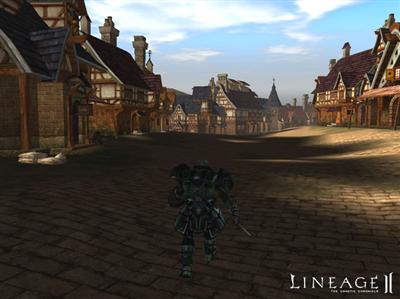
Lineage II is coming.  Lineage was a huge hit in Korea with millions of players taking adventage of broadband network in Korea.  Lineage differs from other MMORPG in that it actively encouraged building large social groups and large scale battles between them (Socialwarfareware!).  Still, the original Lineage was a isometric which is less immersive than full 3D.  Lineage II makes up for it by building on UnrealEngine2 and the result is impressive.

Where the hell is Starbucks in this town?

Check out the Castle Siege gameplay movie (105mb WMV) and others at Lineage II Movies section.  While Lineage battles are smaller than real world battles, it really feels like a real battle with swirling chaos and spirits soaring or plummeting in an eye blink.  Amazing stuff.  It will be interesting to see if Lineage II with it's strong social features can take off in America.

Serts

It's 4AM and I am thinking about serts.  No, not certs.  Serts, as in Asserts.  Cute, eh?  It's a term I came up with to describe cert-like objects except it's just signed piece of information about anything where a cert is a signed information about a person.  A sert can be a signed grocery list or a list of weapons on board a ship.  A sert is just data signed by someone or something.

Think of serts as anonymous certs gone wild.  Say I visit a website and the website can distinguish me from other visitors using whatever means handy like cookies.  Over time, the website gets to know me.  So it hands me a sert that say "I don't know who this guy is but he has been trustworthy for these sort of activities."  Does that sert have value?  I think so.  Does it matter who I am?  Not really.  That's a sert for you.

World needs serts because everyone could use a bit of sertainty.