BitTorrent Model for Tech Sales

Reading Scoble's post on Dave's sour encounter with Best Buy and Scoble's suggestions on how to improve the tech sales/purchase experience made me think about the problem as well (the blogosphere is like this in that blog posts are like can openers.  Reading a post could open your can.)

A sales person, no matter how carefully you choose them, will be cluess about most of the product he is assigned to sell.  The first problem is that they lack the motivation to learn.  The second problem is that they are not excited about the product.  They are just clueless people who just wants to sell it and don't care whether the buyer is making the right purchase or not.

One solution I can think of is rather outrageous and could have some legal implications.  The core idea is to let customers sell to each other in return for discount coupons.

If I am really excited about a newly released laptop from HP, I would have scoured the net for information about the laptop and would be far more informed than your average sales person pushing HP products at stores.  Chances are also pretty good that I would be more informed than an employee of HP.  All those hours spent learning about the product are valuable.  Geeks are like that.

Now I walk into Best Buy to buy a laptop.  At this point, I know which laptops they carry and which ones I am interested in.  Only remaining issue at this point is the price.  If Best Buy offered me a $100 discount coupon on any product I help them sell, I would be looking around to see if anyone else is looking at the laptops I know about.  While I am not going to hang around for hours waiting for someone to come, I am very likely to tackle anyone who might be interested in the laptops I buy so I can get that discount coupon.  It doesn't matter how many figures I make a year.  It's the human nature thing.

The chance of me making a sales is arguably higher than a sales person because a) I am well informed about the products, b) I am highly enthusiastic about the products, and c) I am a peer.  Although I am doing this partly for that $100 coupon, I wouldn't be doing it unless it's an effort in the same direction I am going anyway.

This model is similar to the way BitTorrent works.  While I am downloading something via BitTorrent, I am sharing what I downloaded so far with other downloaders in return for faster downloading speed.  While I am making a purchase, I am sharing my knowledge and energy with other potential purchasers in return for discounts.

Too creative?  Well, consider the idea to be raw ore that needs further processing.  I am just a miner.

Update (11/29/2003)

There are some really good comments to this post, so don't forget to read them.  Also, Jason Lefkowitz and his father discussed the idea over Thanksgiving and came up with a possibly workable variation which discusses in a Anthill Communities blog post.  Interesting.

One potential pitfall in the idea seems to be that there won't be enough 'peers' hanging around to help or that they would be looked up on with suspicion.  I think it depends on the how the 'peer sales' business is designed.  A store 'well-known' as the place to go for geeks will attract enough during busy hours.

It is well known that people's behavior is highly contextual, particularly by where they are.  If the store encourages 'conversations' among customers in the store, customers will remember that store as the place to go to find others with whom they can talk to about products they are interested in.  As to the number, all you really need is one customer who is either knowledgeble or has friends who are.  Even if everyone present is clueless, there is certain comfort in asking others what they think of the product one is interested in.

Ultimately, it all depends on how the business is designed and how attractive the sales atmosphere is.  Think about the night club business and what it takes to create a successful night club.  In a sense, night clubs are peer sales business because it depends heavily on how customers interact with each other.  While I am not advocating that tech stores put bouncers at the door to control the quality of customers, encouraging certain types of customers to visit through marketing and in-store incentives will influence the sucess of the business.
BlogStAX: Using StAX to Parse RSS 2.0

Last night, I wrapped up the first release of my RSS 2.0 parser using the StAX API.  It's tentative name is BlogStAX and you can download it from the BlogStAX page.  Beside the obvious speed, you might find its design rather interesting.  While it is definitely not a turkey, consider this my Thanksgiving present to the open source community. 🙂

FYI, BlogStAX doesn't validate RSS feeds.  It used to validate and report the errors via the RSSValidationListener interface, but I ripped it out because validation checks were not complete.

Where is the Syndication in RSS?

Gary Lawrence Murphy is being bombarded with RSS requests.  Where is the syndication in RSS when majority of RSS feeds are directly consumed?  With a good RSS news aggregator, it's just too easy to subscribe and forget.  Are you as vigilant in unsubscribing from uninteresting feeds as you are in subscribing to interesting feeds?  I don't think so.  Scale it up and you can see the problem.

Each of us as readers don't fully appreciate how much RSS data each of us are downloading everyday or every hour.  Me?  I am pulling down tens of megabytes every morning.  Am I reading tens of megabyes of information every morning?  Not even close.  I'll read maybe half a megabyes at the most and I'll be scanning most of that even which leaves only a hundred kilobytes of information which I do actually 'read' every morning.

While RSS allows information consumers to efficiently cover large number of information sources, the efficiency is subjective and there are wastes that we should be more concerned about and continue to strive against before it can sink us all.

Frankly the Constitution is Vulnerable

General Franks say that harsh reaction to a WMD (Weapons of Mass Destruction) attack on America could destroy the Constitution.  I agree with him.  America is a loaded gun without a safety mechanism.  As individuals, we are intelligent and reasonable.  As a nation we are as reasonable as an angry penguin on ice.

Even the typical wimpiness of Democats, usually a reliable counter-balance to typical boneheadedness of Republicans, evaporate when the Nation is attacked with shocking force.  While the Constitution can safeguard against abuse of power, it offers no protection against lossing our collective heads.

Unfortunately, I don't see a workable safety mechanism against this.  I don't think mandatory cooling off period has any chance as an amendment to the Constution.  My only consolation is that I am not on the working end of that loaded gun.

Religion

Beside my little weekend coding project, I am looking within myself to find out why I am religiously-challenged.  I can see both the benefits and the cost of having a religion and, overall, having a religion is a good deal although mileage differs depending on the religion.  My problem is that I can't get it even if I wanted it, a disability of the religious-kind.

I do think there might be one or more divine beings, things, or forces.  I know that science can't explain everything and, so called hard science, is just a house of cards built on guesses guided by theories and observations.  So far the theory of gravity holds although it's not the theory that keeps my feet on the ground.

My attitude is that if there is a divine being and I have no way of confirming the being's existance except by a leap of faith, the being's existance doesn't matter to me.  Also I don't like the idea of a divine being affecting my life with invisible hands whether it's for my benefit or not.  What is the point of crying about privacy if there are divine beings hanging around watching you all the time?

In the few occasions I found myself inside a church, I saw a half-naked man hanging on a wall.  When I listen to the silence and expressions on the faces of the worshippers in the church, I could literally feel a gentle breeze of faith swirling around me.  It made the hair on the back of my head standup.  It was like the church was filled with a huge invisible person wished into being by the worshippers and I was inside his bowel.  I don't like being inside anyone's stomach.

I think my unusually imaginative mind is part of the problem.  Unfortunately, I have little control over my mind automatically summing up what I observe and presenting the result as senses of visions, sounds, or smells.  If you don't know what I am talking about, think about the common expression "it stinks."

So, I want to but can't get religion.  I think it is possible to dig into deep recesses of my mind and rewire the parts that prevents me but that would raise the cost of having a religion too high.  It just wouldn't be me afterward, sort of like losing my mind to another persona.  Anyway, it was Sunday, so I thought about religion.  I hope what I wrote for my sake doesn't offend you.

OCSP Weekend

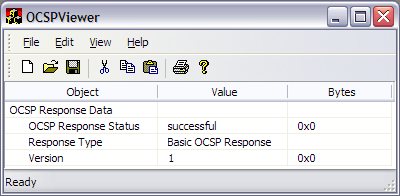
While my wife and son are visiting the San Francisco Zoo with my son's cubscout den, I am at home putting together an OCSP object viewer.  Here is a snapshot of what I got so far.

It's showing an OCSP response data which is DER-encoded.  The grid is actually a tree view control with multiple columns.  I'll have to whip up some icons for different types of ASN.1 objects though.  I am using OpenSSL to parse the data but it's just too heavy and console-oriented for my purpose.  When I have more time, I'll turn it into a generic ASN.1 viewer.

Supercavitation

I did some reading in the supercavitation effect this morning.

Supercavitation is the underwater version of a faster-than-light (FTL) space travel method popular among science-fiction writers which involves creating a hyperspace bubble around a spacecraft.  Supercavitation creates an enveloping bubble of low-pressure gas around an object so it can move at speed typically associated with aircrafts.

The human drama surrounding the technology is as fascinating as the physics behind it.  Russia, which had supercavitation torpedos for decades, supposedly exported them to some countries like Iran.  Iran?  I didn't even know they had submarines!

One downside of supercavitation is the fuel to propell the object fast enough to trigger the supercavitation at the specially shaped head.  Supercavitation torpedos use jet fuel.  I can't imagine what underwater supercavitation sub-carrier need to use.

Ultimately, I think noise and operational hazards will prevent development of supercavitating submarines.  Supercavitation bubble imposes some navigation constraints and if a submarine moving at 200 mph can't avoid a whale or a school of tuna, we are talking pretty big repair bills.

Packaging OCSP Responses

Is there a standard format for packaging multiple OCSP (Open Certificate Status Protocol) responses into a single file/stream?  A digitial signature validation could result in multiple OCSP responses and letting users deal with multiple DER files is too awkward from usability point of view.

For now, I am thinking of storing multiple BASE64-encoded OCSP responses in a XML file.  Properly designed, the XML format should be able to store other information related a valdiation session such as OCSP requests, signature itself, implementation bits, etc.  This way it can be used as a general log of a validation session which can be used as a proof of validation.

Also I have noticed that, although there are many tools and software for OCSP developers, there aren't many tools for users.  For example, a simple GUI-based OCSP response viewer could be pretty handy.  An embeddable version would be even better so I can use it to build a viewer for the 'OCSP Log' file I mentioned above.

Railroad Servers

I ran into an ad for Railroad Tycoon 3 just now and started thinking how nice it would be to have railroad servers for me to visit and to build within.  What is a railroad server?  It's basically a persistent, modifiable 3D model server specialized in trains, tracks, passengers, buildings, and landscapes.  Well, maybe some cowboys and indians.

One would need a client to view it, but a browser plug-in should make it easy enough to use.  One thing nice about it is that there is no pressure to chat.  Just the quiet immersive view for relaxing and occasional trains that goes by or to ride on.  If another person is nearby one can chat, but it's optional.  Some people would choose to build trains, train stations or buildings.  Others would play with the landscape.  Railroad servers could be connected to each other so one could 'ride' from one server to another, crossing continents and time periods.

Railroad servers might seem boring when compared to MMORPG games like EverQuest but I think they are more appealing to the mature crowd and train enthusiasts.  Is there a business model?  Nope.  But I wouldn't mind paying a few dollars a month to have a little patch of land on a railroad server for me laydown my own tracks and to run my trains.

I guess one could even stretch the idea into the realm of social networking software.  The problem with traditional social networking services like Friendster or LinkedIn is that there is no place go.  It's like dating on a piece of paper or holding a meeting in the dark.  A Place serves as an excellent context/medium for social connections.  Lacking cohesive context, a social network is no different from a bag of marbles.  Open the bag and marbles will roll out.